
The different facets of ourselves and our experiences are inexorably intertwined in our work and our research. As academics, we make choices about how explicit or visible we want this intertwining to be. When I first read “Trauma-Informed Computing“, in the first semester of my doctoral degree, I saw an path forward to make the connection between my experiences and my work in a productive and collaborative way. I made a decision to call myself a trauma-informed researcher (T-IR), and a commitment to embody the principles in my work and research practice. I am the kind of person who would disproportionately benefit from trauma-informed design and research; when I commit to being trauma-informed in my practice, I choose to honor and respect myself as a victim and a survivor. I attended the trauma-informed design workshop that was held at CSCW 2023, about a year after I first read the paper, and it reaffirmed that commitment for me.
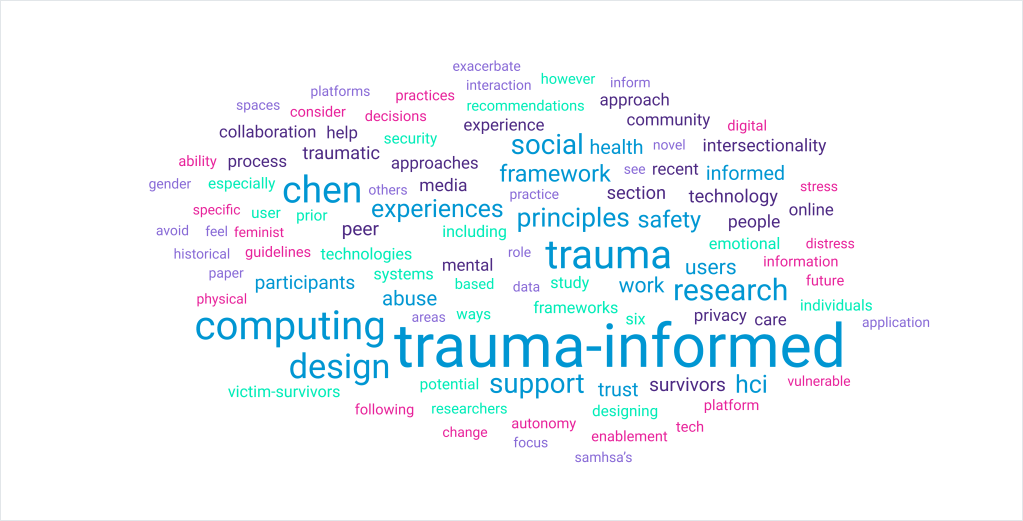
This blog post shares a project I completed over the course of this spring semester 2024 for the requirements of Dr. Leysia Palen‘s class, HCC Survey and Synthesis: Foundations and Trajectories. For this project, I analyzed the academic impact of “Trauma-Informed Computing” by performing a content analysis of the papers that have cited it since its publication in CHI 2022. I had several goals in conducting the project. First, I wanted to reinforce my commitment to being a T-IR by familiarizing myself with the work of other scholars who had made that commitment (at least to the extent that they cited the paper), and make a reading list. Secondly, I wanted to get a feel for how faithful the dataset I created was to the original paper. Thirdly, I wanted to exercise skills related to reviewing literature, and think more deeply about the messy science of citation.
I choose to share the work that I did here because I want to initiate reflection and conversation from other scholars who may or may not have made a commitment to being a T-IR like I did, or who just want to engage in deeper reflection about how we read and cite academic work.
This folder contains PDFs of each paper I analyze, the Google Sheets document where I did my content analysis, and the final report I compiled of my findings and reflections.
 Faye Kollig
Leave a comment