
(written April 25, 2023)
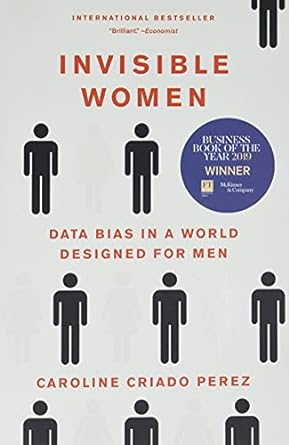
Caroline Criado Perez’s acclaimed book, Invisible Women, is a thorough and compelling case for what she names the gender data gap, the pervasive and consequential lack of sex-disaggregated data and data that is not centered around the priorities and bodies of men. She talks the reader through dozens of case studies and (where available) research and statistics that evidence this gap, dividing these according to six overarching categories: daily life, the workplace, design, medicine, public life, and disaster relief.
Even though it was written in the past five years, this book feels a little outdated. The choices made in its construction come together to create something that feels deliberately palatable. Criada Perez injects personal voice and anecdotes at opportune moments, as well as a kind of exasperated humor that is extremely appealing. She often includes clauses like “if a woman had been involved” or “if they had asked any woman” that soften the gap she talks about into something that seems often to derive from sheer ignorance. While she is not shy about outlining how serious the consequences can be (from drugs working less often (215) to car safety mechanisms working less often (186-191)), the blame is more diffuse. She frequently mentions that the changes that would address the gender data gap would make the world a better place for everyone, a call to interest convergence that feels highly intended and political, and positions this book as accessible (emotionally and cognitively) to people who are not already cognizant of the issues she discusses.
Another quality of Invisible Women that improves general accessibility is its conviction. The strength of the language that is used to bind together statistics, case studies, anecdotes, interviews, and conjecture makes all of it feel on equal footing in damning power. Judgements (“this lazy byproduct of male default thinking is inexcusable in a media report…” (97)) bump right up against citations of all kinds. It is persuasive rhetoric that creates an argument cohesive in tone and easy to believe.
However, part and parcel of this palatability is a marked dis-inclusivity. The book’s introduction is labeled the default man; ironically, in her effort to counteract the basis of society on him, Criado Perez creates something of a default woman. She is cisgender, straight, not intersex, fertile, small in stature, and often a mother; she is deliberately raceless, and she is asexual, except when she is assaulted. She is the woman that is neglected as a result of the gender data gap, and the way she is defined in the narrative makes visible these important traits about her and vanishes the traits the author does not seem to a) (generously) be able to support and/or b) (cynically) care to write about. Criado Perez includes a thorough accounting of sex and gender on the axes of culture, socioeconomic class, sphere of life, and nationality, but the intersectionality [2] of the woman she cares about is extremely limited. More recent works, like D’ignazio and Klein’s 2020 book, Data Feminism [3], cite Invisible Women and take it steps further. But the intersections neglected in this book are not novel to the past five years; trans, queer, Black and Brown, single, childless, and sexual women and femmes have always existed and have been writing for a long time. Donna Haraway’s Cyborg Manifesto comes to mind, and in particular her assertion that “…there is nothing about being ‘female’ that naturally binds women…Gender, race, or class consciousness is an achievement forced on us by the terrible historical experience of the contradictory social realities of patriarchy, colonialism, and capitalism” [4].
Criado Perez hints at a knowledge of this constructedness in the introduction of the book, when she notes that (differentiated from sex), gender refers to “the social meanings we impose upon those biological facts – the way women are treated because they are perceived to be female…sex is not the reason women are excluded from data. Gender is…the female body is not the problem. The problem is the social meaning that we ascribe to that body, and a socially determined failure to account for it” (xvii-xviii). This is the closest she gets to emancipatory ideology in the book; there is remarkably little acknowledgement of structures of power or oppression for a book about a systemic problem, discarded in favor of situational or interpersonal factors like ignorance or budget, or even tendencies towards passive language.
Outside of its palatability, which many might consider a necessary evil for a bestselling work of nonfiction, Invisible Women is a well-written expression of a potent problem. The lack of data, the lack of good data, or the lack of good data science around axes of sex and gender is just as pervasive in 2023 as it was when the book was written. AI and ML models and algorithms replicate the same societal inequity that underlies the case studies Criado Perez narrates, including a tendency to mislabeling and objectification, or, often, both at the same time [5]. Those who are attuned to ethical issues across the technology sector will find a familiar catalog of representation problems in the Silicon Valley-facing chapter 9 of Invisible Women, entitled “A Sea of Dudes”. In the current world, where we often feel like there is too much data being collected, the word “gap” might feel outdated, but while Criado Perez mostly defines the gender data gap by what is not collected, she emphasizes that data must be properly handled and applied to be useful. This dimension of the gender data gap is perennial in discussions about big data and generative AI [6, for example], as well as in discussions about harm perpetrated through data against marginalized groups (people who get abortions, for example)
D’ignazio and Klein [3] call Invisible Women an attempt to categorize responses to the question, “who benefits from data science and who is overlooked?”. By that metric, Criado Perez’s answer is clear: men, and women, in that order. While more nuanced discussions and discussions of solutions beyond representation are missed, Invisible Women is a quick read, a good starting point, and an effective call to the table for people who might not consider feminism a relevant part of data and tech science. Once we’re here, though, we have a lot more things to talk about.
Sources Used
[1] Ihudiya Finda Ogbonnaya-Ogburu, Angela D.R. Smith, Alexandra To, and Kentaro Toyama. 2020. Critical Race Theory for HCI. In Proceedings of the 2020 CHI Conference on Human Factors in Computing Systems (CHI ’20). Association for Computing Machinery, New York, NY, USA, 1–16. https://doi.org/10.1145/3313831.3376392
[2] Crenshaw, K.W. (1991). Mapping the margins: intersectionality, identity politics, and violence against women of color. Stanford Law Review, 43, 1241-1299.
[3] D’ignazio, Catherine, and Lauren F. Klein. Data feminism. MIT press, 2020. Chapter 1: The Power Chapter.
[4] Haraway, D. (1991) “A Cyborg Manifesto: Science, Technology, and Socialist-Feminism in the Late Twentieth Century”. Simians, Cyborgs and Women: The Reinvention of Nature. Routledge. ISBN 0415903866.
[5] Kyra Yee, Uthaipon Tantipongpipat, and Shubhanshu Mishra. 2021. Image Cropping on Twitter: Fairness Metrics, their Limitations, and the Importance of Representation, Design, and Agency. Proc. ACM Hum.-Comput. Interact. 5, CSCW2, Article 450 (October 2021), 24 pages. https://doi.org/10.1145/3479594
[6] Morgan Klaus Scheuerman, Jacob M. Paul, and Jed R. Brubaker. 2019. How Computers See Gender: An Evaluation of Gender Classification in Commercial Facial Analysis Services. Proc. ACM Hum.-Comput. Interact. 3, CSCW, Article 144 (November 2019), 33 pages. https://doi.org/10.1145/3359246
 Faye Kollig
Leave a comment